
Driving a Campervan in Wind: How Size, Stability and Vehicle Design Matter
Wind is one of those road conditions that can change the character of an RV trip surprisingly quickly. A steady breeze may barely be noticeable, while strong crosswinds and sudden gusts can require considerably more attention from the driver. Open plains, exposed bridges, mountain passes and the moment a vehicle emerges from behind trees or another windbreak can make those effects particularly noticeable.
For RV travelers, the way a vehicle responds to wind is influenced by much more than its classification as a Class A, Class B or Class C. Overall height, side profile, wheelbase, weight distribution, chassis design, tires, suspension and electronic stability systems all play a role. Towing introduces another set of dynamics because the tow vehicle and trailer must respond together.
This is one reason driving characteristics deserve consideration alongside floorplans, appliances and camping features when comparing RVs. The Mini-T Campervan lineup provides an interesting example because it spans several vehicle platforms and sizes, from lower-profile vans and passenger minivans to a heavy-duty high-roof Transit. Each approaches the road somewhat differently, illustrating how vehicle design influences the experience long before the campsite is reached.
Why Wind Affects RVs Differently
A crosswind acts against the side of a vehicle. As vehicle height and exposed side area increase, there is generally more surface for the wind to act upon. That helps explain why drivers often notice crosswinds more in high-profile vehicles than in lower passenger vehicles.
Trailers introduce additional considerations. A towable RV has its own side profile, tires, suspension and weight distribution while being connected to another vehicle at the hitch. Under some conditions, wind and other forces can contribute to trailer sway, making appropriate speed, loading, equipment and driver response especially important.
A campervan eliminates the articulation between a tow vehicle and trailer because the living space and vehicle are one unit. Within the campervan category, however, dimensions still vary considerably. Some Class B RVs are tall, extended vehicles, while others are based on lower-profile passenger vans or smaller commercial vans.
The practical lesson is not that one type of RV is unaffected by wind. It is that vehicle dimensions and design influence how the vehicle responds and how much changing wind conditions may be felt by the driver.
Electronic Stability Control Adds Another Layer
Vehicle stability today is not determined by suspension and tires alone. Electronic stability control has become an important part of vehicle design and adds another layer between the driver's inputs and the vehicle's response to changing conditions.
These systems use information from vehicle sensors to compare what the driver is asking the vehicle to do with how the vehicle is actually moving. When the system detects a loss of directional stability, it can selectively apply braking and, depending on the system and circumstances, adjust power to help the driver maintain control.
Electronic stability control does not cancel the laws of physics, and it does not make excessive speed or severe weather safe. Its purpose is to assist vehicle stability when conditions begin moving the vehicle away from the driver's intended path.
That distinction is important when considering RVs. Rather than thinking only about how large or small a camper is, it is worth understanding the underlying vehicle platform, its chassis and the stability technologies incorporated into it.
Different Platforms, Different Road Characteristics
The Mini-T Campervan lineup spans several vehicle platforms rather than a single size or configuration. Ford Transit Connect Mini-T Campervans established the low-profile approach long associated with the Mini-T, while Chrysler Pacifica and Voyager Mini-T Campervans bring the road manners of a passenger minivan to Class B RV travel. The Mini-T HR expands the concept into a larger high-roof campervan on a heavy-duty Ford Transit chassis.
These vehicles do not respond identically to wind. Their dimensions, weights, wheelbases, drivetrains and chassis configurations differ, and those differences should be acknowledged rather than reduced to a single claim about wind handling.
What they demonstrate collectively is a broader point about RV travel: the underlying vehicle matters. Driving is part of camping travel, whether the day involves an interstate, a scenic byway, a small town, a grocery stop or the road leading into a campground.
Pacifica and Voyager Mini-T Campervans: Passenger-Van Road Manners
Chrysler Pacifica and Voyager Mini-T Campervans are based on passenger minivan platforms. Their relatively low profile compared with many conventional motorhomes means less tall bodywork is presented to a crosswind, while their unibody construction and passenger-vehicle origins provide driving characteristics familiar to people accustomed to cars, crossovers and minivans.
The Pacifica Mini-T is also available with all-wheel drive. AWD is primarily a traction feature rather than a solution for crosswinds, but that distinction becomes useful when considering travel through changing conditions such as rain, snow and other low-traction situations.
Traction and stability are related, but they are not the same thing. AWD can help distribute driving force when traction is limited, while electronic stability systems are designed to help manage vehicle direction and stability. Neither removes the need for appropriate speed, suitable tires and good judgment when weather deteriorates.

The Transit Connect Mini-T and the Advantage of a Low Profile
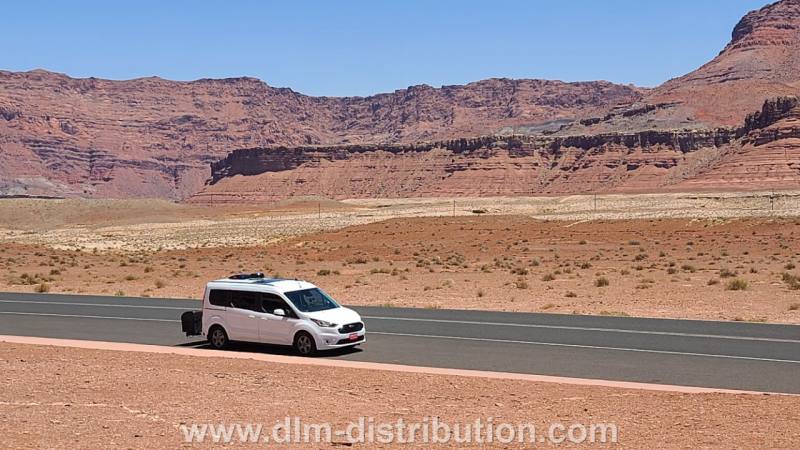
The Ford Transit Connect Mini-T Campervan represents another low profile RV in the Mini-T family. Its relatively low height and small overall footprint mean there is less side area exposed to crosswinds than on a tall motorhome.
Those dimensions influence much more than windy-day driving. The Transit Connect Mini-T fits into normal parking spaces, can be kept in a residential garage where dimensions permit and retains the maneuverability of the compact van platform from which it is manufactured.
It is a useful illustration of how RV practicality extends beyond what fits inside the camper. Height, width and overall footprint also affect where a vehicle can be parked, stored and driven, as well as how it responds to conditions encountered along the way.

The Mini-T HR Takes a Different Approach
The Mini-T HR is intentionally a larger and taller member of the Mini-T family, so its relationship with wind is naturally different from that of the lower-profile models. The tradeoff is greater interior height and space, supported by a substantially different chassis underneath it.
The Mini-T HR uses a heavy-duty Ford Transit chassis with dual rear wheels and all-wheel drive. The dual-rear-wheel configuration places four tires across the rear axle, creating a wider rear tire footprint and distributing rear axle loads across four tires rather than two. The chassis, suspension and vehicle architecture are designed for the demands associated with heavier-duty commercial and RV applications, while AWD provides additional traction when road surfaces become slippery.
The Ford Transit platform also incorporates electronic vehicle-control technology designed to assist stability. Depending on model year and configuration, Transit systems can include AdvanceTrac with Roll Stability Control and technology designed to help the vehicle respond to side-wind disturbances.
None of those features makes a high-roof campervan immune to crosswinds. The Mini-T HR presents more side area to the wind than a Pacifica, Voyager or Transit Connect Mini-T, so changing wind conditions can naturally be more noticeable. The important point is that its larger size is paired with the heavy-duty chassis, dual-rear-wheel configuration and vehicle-control systems appropriate to that platform.

Understanding the Role of Dual Rear Wheels
Dual rear wheels are often discussed primarily in terms of load capacity. Two tires on each side of the rear axle spread rear axle loads across four tires and are part of the overall engineering of a heavy-duty chassis.
They should not, however, be interpreted as making a vehicle unaffected by crosswinds. Wind response involves the complete vehicle: height, side area, weight, wheelbase, suspension, tires, steering, speed and electronic control systems all contribute to what the driver experiences.
For the Mini-T HR, the dual-rear-wheel configuration is therefore best understood as one element of a larger heavy-duty vehicle platform rather than as a standalone wind-handling feature.
Wind Is Only One Part of Changing Road Conditions
A vehicle's road manners matter well beyond windy days. Long-distance travel can involve heavy rain, standing water, rapidly changing temperatures, mountain grades, snow, ice and everything from narrow park roads to multi-lane interstate highways.
No single feature addresses all of those conditions. AWD can assist with traction. Electronic stability control can assist with directional stability. Anti-lock braking can help maintain steering control during hard braking. Tires provide the vehicle's actual contact with the road, making their condition, pressure and suitability for the season especially important.
Vehicle dimensions matter as well. A campervan that remains manageable in normal parking areas and on ordinary roads can simplify a trip that includes cities, scenic byways and everyday stops in addition to campgrounds.
This leads to a broader way of thinking about RV practicality: not simply how comfortable a vehicle is after it has been parked, but how naturally it fits into the entire journey.
When the Wind Becomes Strong, the Rules Change
There is an important limit to every discussion of RV wind stability: severe wind should be treated as a weather hazard regardless of what RV is being driven.
When conditions become windy, reducing speed gives the driver more time to respond to sudden gusts. Keeping both hands on the wheel, increasing following distance and anticipating exposed areas can also help. Extra attention is warranted on bridges, across open terrain and when passing or being passed by large vehicles, where airflow and wind conditions can change abruptly.
Weather forecasts, warnings and roadside advisories matter as well. If winds become severe enough that travel is hazardous, the appropriate response may simply be to stop traveling and wait for conditions to improve. A lower vehicle profile, AWD, dual rear wheels or electronic stability technology should never be interpreted as permission to disregard dangerous conditions.
And when severe winds or thunderstorms threaten while camping, an RV should not be treated as a storm shelter. Knowing where a substantial building or designated shelter is located can be just as important as knowing where the next campsite is.
A More Useful Way to Think About RV Road Manners
RV comparisons often begin with floorplans, beds, kitchens and storage. Those things certainly matter, but every RV also has to travel down the road before it reaches the campsite.
Overall height and width, wheelbase, chassis configuration, drivetrain, tires, suspension and electronic stability systems can reveal a great deal about how a vehicle may fit into the travel experience. A thoughtful test drive on different types of roads can be equally informative.
The different Mini-T platforms illustrate the tradeoffs clearly. The Transit Connect Mini-T emphasizes a very low profile and small footprint. Pacifica and Voyager Mini-T models bring passenger-minivan dimensions and driving characteristics to campervan travel. The Mini-T HR provides greater interior height and room while pairing that larger body with a heavy-duty AWD, dual-rear-wheel Transit chassis.
None eliminates weather, and none changes the need for good driving decisions. They simply represent different ways of balancing interior space, vehicle dimensions, chassis capability and ease of use.
The Drive Is Part of the RV Experience
For travelers exploring by road, driving is not simply the task required to get from one campground to another. A day may include a mountain highway in the morning, a grocery store at noon, a scenic overlook in the afternoon and a campground road before dinner.
That is why stability, maneuverability and familiarity behind the wheel deserve a place in the RV conversation. Windy conditions make some of those differences easier to notice, but the value of a well-matched vehicle and chassis extends to ordinary travel as well.
The practical goal is not to find an RV that ignores difficult weather. Such a vehicle does not exist. It is to understand how vehicle size, chassis design and driving characteristics affect the journey, choose a vehicle suited to the kind of travel you expect to do, and recognize when conditions call for slowing down, changing plans or simply staying put.
That perspective makes wind handling part of a much larger conversation about RV practicality. The campsite matters, but so does every mile traveled to reach it.
Happy Camping!
DLM-Distribution / Campervans is a licensed manufacturer and dealer located in Lake Crystal, Minnesota, serving clients around the country.
Contact Dave: 651-285-7089 or Candy: 507-382-9446 today!